5-Minute Evening Brain Dump to Quiet Racing Thoughts and Rest Better

Racing thoughts at night can feel like a fire alarm that keeps ringing after the danger has passed. The body is tired, the room is quiet, and still the mind keeps listing emails, conversations, bills, health worries, family tasks, and things that can only be handled tomorrow.
A 5-minute evening practice can help because it gives the brain a clear place to put unfinished thoughts. Instead of trying to “stop thinking”, the method accepts that thoughts are present and moves them onto paper. That small act can reduce mental load and help the nervous system recognise that it does not need to stay on guard.
This is not a cure for insomnia, anxiety, or trauma, and it is not a replacement for medical care. But as a simple nightly tool, a Brain Dump can make bedtime feel less like a battle and more like a handover.

Why thoughts get louder when the day gets quiet
The mind often seems busiest at night because there are fewer distractions. During the day, chores, messages, meals, commutes, calls, and conversations keep attention moving. At night, the nervous system finally has space to process what was postponed.
Sleep researchers often describe this as cognitive arousal, a state where the brain stays mentally active when the body is trying to rest. This does not always mean something is “wrong”. It can be the brain trying to protect you by scanning for unfinished tasks and possible threats.
A few common triggers include:
An unresolved conversation
A task with no clear next step
Money or health worries
A fear of forgetting something
Too much stimulation close to bedtime
A habit of using quiet time to review the whole day
Psychologists have long studied the pull of unfinished tasks. The idea is often linked to the Zeigarnik effect, which suggests that incomplete tasks can stay mentally active. In plain language, the brain keeps the tab open because it does not trust that the task has been stored somewhere safe.
That is where writing helps. When a thought moves from the mind to a page, it becomes an object. It can be seen, named, sorted, or left for later. The worry may not disappear, but it no longer has to shout to be remembered.
Research on expressive writing, including work associated with psychologist James Pennebaker, also suggests that putting emotional experiences into words can help people organise feelings and make sense of stress. Evening planning studies have also found that writing a specific to-do list before bed may help some people fall asleep more easily than writing about completed tasks. The exact result varies from person to person, but the principle is useful: the brain rests better when it believes important information has been captured.
The 5-minute evening method
This practice is short on purpose. If it turns into a 45-minute self-analysis session, it may increase alertness instead of reducing it. The aim is to empty the active mental queue, not solve your entire life before sleep.
Use paper if possible. A phone can work in an emergency, but screens often bring notifications, brightness, and the temptation to search or reply. A notebook keeps the task simple and contained.
Set a timer for 5 minutes. Stop when it rings, even if the page is messy. The stopping point matters because it teaches the mind that this is a repeatable routine, not another open-ended task.

Minute | What to do | Why it helps |
0 to 1 | Write every thought as it appears | This lowers the pressure to organise too soon |
1 to 3 | Keep going without editing | This catches the small worries hiding behind the obvious ones |
3 to 4 | Mark what needs action tomorrow | This separates real tasks from mental noise |
4 to 5 | Add one closing line | This signals that the page is now holding the thoughts |
Here is the method in detail.
Start with an unfiltered list
Write whatever is in your head. Use fragments, not full sentences. Spelling and grammar do not matter. The page does not need to look calm for the practice to work.
Examples:
Pay electricity bill
Ask about prescription refill
Why did that message sound cold?
Need to pack charger
What if I forget the appointment?
Too much left this week
Buy curd, bananas, and tea
Call plumber
I feel restless for no clear reason
This step works best when there is no judgement. A thought does not need to be logical to be written down. If the mind is repeating it, it belongs on the page.
Keep the pen moving
After the obvious tasks come out, the quieter thoughts often appear. This is why the second and third minutes matter.
If nothing comes, write:
“I do not know what else is in my head.”
“I feel tired but alert.”
“My body wants sleep and my mind wants to check everything.”
These lines are still useful. They name the state instead of fighting it. Labelling an emotion can reduce its intensity for some people because it brings the thinking part of the brain back online. The goal is not to analyse the feeling deeply. The goal is to stop carrying it silently.
Sort only three things
In the fourth minute, look at the page and choose up to three items that need action tomorrow. Put a small star next to them.
Do not star everything. That turns the page into a threat list.
A useful rule is:
Star tasks that are real and time-sensitive
Leave worries unstarred if they cannot be acted on tonight
Add a next step only if it is obvious
For example, “money” is too broad. “Check account balance after breakfast” is a next step. “Health worry” may be too charged for bedtime. “Book doctor’s appointment at 10 am” is clearer, if that is appropriate.
This is where writing down thoughts becomes more than venting. It gives the brain proof that tomorrow has a plan.
End with a closing line
The final line tells the nervous system that the session is complete. It may feel awkward at first, but repetition helps. The line acts like a mental full stop.
Try one of these:
“This is written down, and I can return to it tomorrow.”
“I do not have to solve this in bed.”
“The page is holding this for tonight.”
“My next step is clear enough.”
“Rest is the task now.”
Keep the line plain. It does not need to be poetic or perfectly reassuring. It only needs to be believable.
What to write when the thoughts feel chaotic
Some nights are not neat. The mind jumps from a grocery item to an old embarrassment to a work problem to a fear about the future. This is common when the body is in high-alert mode. The page can still help, but the format may need to be simpler.
Use one of these low-pressure formats.
The messy list
This is best when thoughts are fast.
Write one thought per line. No categories. No order.
Example:
Need to reply to cousin
Strange pain in shoulder
Forgot to soak dal
Presentation worry
Too many tabs open
Why am I still awake?
Must wash bottle
Rent due next week
When the timer ends, choose three next steps at most. Leave the rest.
The two-column page
This is best when tasks and worries are mixed.
Things I can act on | Things I cannot solve tonight |
Pack lunch box | Whether someone is upset with me |
Send document tomorrow | What will happen next month |
Book cab for morning | The whole week feeling heavy |
This format is useful because it reduces false urgency. Many racing thoughts pretend to be tasks, but they are really feelings, predictions, or fears. They deserve care, not a midnight planning session.
The “open loops” list
This works well for people who wake up thinking, “I forgot something.”
Write:
People I need to reply to
Things I need to carry
Bills or forms
Home tasks
Health or appointment tasks
Errands
Decisions waiting for later
This is still a form of journaling, but it is practical rather than reflective. It is designed for chaotic thoughts, not for creating a polished diary entry.
How to keep the practice from becoming another task
A bedtime brain dump should feel like relief, not homework. If it starts to feel heavy, reduce it.
Make it easy enough that it can be done on a tired night.
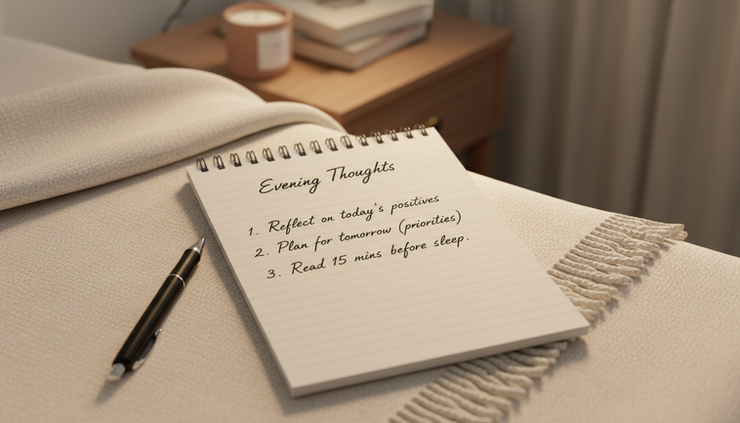
Keep the notebook visible, perhaps near the bed or wherever the evening routine happens. Use any pen that writes smoothly. Do not buy a special journal unless that genuinely makes the habit easier. A plain school notebook works.
A few guardrails help:
Stop at 5 minutes
Long sessions can wake the mind up. If a topic needs more attention, write “continue tomorrow” and close the notebook.
Do not solve emotional conflicts in bed
If a difficult conversation appears on the page, capture it. Avoid drafting long messages at night unless there is a real emergency.
Avoid turning the page into a performance
No colour coding is required. No perfect handwriting. No beautiful layout. The page is a tool, not a display.
Use a repeatable closing action
Close the notebook, place the pen on top, switch off the lamp, or take three slow breaths. The body learns through repeated cues.
Keep it separate from daytime planning
If the list needs proper planning, do that in the morning. Bedtime is only for capturing and calming.
This matters because sleep routines work partly through association. When the same simple sequence happens each night, the brain begins to connect it with winding down. That is one reason sleep hygiene advice often suggests a consistent bedtime routine. The routine does not force sleep, but it reduces mixed signals.
A sample 5-minute page
Here is what a real-looking page might contain. Notice that it is not elegant.
Need to pay broadband bill. Ask manager about leave dates. I feel tense about that comment from the meeting. Buy vegetables. Pack umbrella. What if I miss the deadline? Call Amma. Shoulder still feels tight. Too many small things. Book dentist appointment. I cannot fix the whole week tonight.
Starred for tomorrow:
Pay broadband bill
Ask about leave dates
Pack umbrella
Closing line:
This is on paper now. I can return to it after breakfast.
That is enough. The unstarred items are not ignored. They are simply not assigned to bedtime.

What if the thoughts come back after the notebook is closed?
They might. That does not mean the method failed. A busy brain often checks whether the system can be trusted.
If a thought returns, try this quiet response:
“That is already on the page.”
If it is genuinely new and important, add one line to the notebook without restarting the full practice. Then close it again.
If the same worry returns again and again, it may need daytime attention. Set a small “worry appointment” for the next day, perhaps 10 minutes after lunch or in the early evening. During that time, write possible next steps, talk to someone trusted, or decide whether professional support would help.
Seek help from a qualified professional if racing thoughts are frequent, severe, linked with panic, trauma, depression, or major sleep loss, or if they affect daily functioning. Self-help tools can support care, but they should not replace it when symptoms are intense.
The takeaway
The aim of a 5-minute evening brain dump is not to empty the mind forever. The aim is to show the mind that its concerns have been heard and stored.
Keep the practice short. Write without editing. Mark only a few next steps. End with a line that tells the brain, “This can wait until tomorrow.”
Some nights, the page will feel calming. Other nights, it may simply reduce the noise by a small amount. That still counts. Rest often begins with one modest signal of safety, repeated often enough for the body to believe it.


Comments